Events Calendar

- This event has passed.
The Night Sky in May and June
As we approach the summer solstice and the longest day of the year, Sat 20th June, Northumberland starts to lose the dark skies that characterise it. From May to middle of August, we lose the darkness and enter into a dusky night. The reason for this is due to the tilt of the earth and Northumberland’s position on Earth, we are not far south of the Arctic Circle.
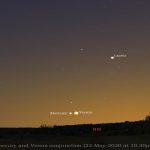
Even though it’s going to get difficult to watch the stars, it is a good opportunity to look for Venus during the evening sky. It’s been appearing the sky the last few months, getting more and more bright at the time it’s moving closer to us, but in a few weeks time, at the start of Jun, it’s going to be between us and the Sun, disappearing from the sky and will back to appear later in June during the early mornings. But before this happens, Venus is going to be closer to Mercury, this so-called Conjunction will be seen in the evening of May 22nd. Mercury is a difficult planet to see most of the time. So, this is a good time to look for it, because it’s going to be easy to find it next to the brighter Venus.

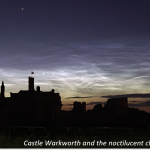
The fact that it doesn’t get dark, doesn’t make it less interesting, the summer night sky brings us some nice surprises too. Residents of Northumberland are ideally placed to see a wonderful phenomenon (and my favourite so far) from late May until early August: The noctilucent Clouds (NLCs). These interesting clouds are the highest clouds in the atmosphere, formed in the upper layer of the poles and reach heights of fifty miles above ground and can be seen further south. They stand out from the rest of the cloud for their particularly electric blue colour, which make seem like they are shining.
These clouds are fed with water vapour, meteor dust and it’s believed to be linked with the raised of the temperatures provoked by the climate change. The first appearance was registered in the 18th century after the Volcano Krakatoa erupted.